
Manila has been the epicenter of basketball these past few weeks with the Philippines hosting the FIBA Basketball World Cup. The country has done an amazing job showing the world how devoted to basketball we are as a people. We relish the fact that we’re a basketball-crazy nation, even, at times, to a fault. We lost ourselves amid all the excitement of not just hosting the games but also rooting for our national team.
Sadly, what should have brought us closer together has become a cause of division. In any team sport, there’s nothing uglier than turning against each other. With Gilas Pilipinas finishing the first round of competition last in its group with a disappointing 0-3 record, the pitchforks and torches came out, the angry mob demanded blood, and head coach Vincent “Chot” Reyes became public enemy number one.
I had lunch with Coach Chot last Friday, just barely a week after Gilas’ final game in the World Cup. We got to talk about what’s been on his mind following the tumultuous campaign.
ALSO READ
The Rage Directed at Chot Reyes Has Gotten Out of Hand
'There's Never Been a Better Time to Be a Fan of the NBA in the Philippines'
Genesis
Reyes’ calling as a basketball coach was first born out of necessity at a young age. Then a point guard for Ateneo de Manila back in the early ‘80s, he became a young dad before graduating from university.
“I was still playing sa college team sa seniors and I was also coaching PAYA aspirants by necessity because we already had Josh,” he says. “Father Holscher sa Ateneo high school was looking for a coach and so he asked me.”
While other kids his age were partying and enjoying college, Reyes was busy juggling two jobs, the demands of being a student-athlete and the needs of his new family.
“I was a working student,” he recalls. “I was working part-time for the Department of Transportation and Communications and then I still continued my classes. I couldn’t stop or drop because I was on scholarship so I had to maintain my QPI. I had a window between the end of my class and the start of seniors practice at 6-8pm so yun yung eksakto practice ng aspirants. Between 3 to 6pm I had that window. That’s where it started. I was second year college. I was already coaching first year and second year high school kids and part of that first group were sila Danny Francisco and Olsen Racela.”
Reyes comes from a basketball family that breeds point guards. He and his four brothers all played the same position. His brother Jun played for Alaska in the PBA and on the national team, and so did his nephew Jai who followed in their footsteps as a court general for Ateneo during the five-peat era in the late 2000s before making it to the pros. The Gilas coach was never able to pursue a career playing basketball but looking back, the 60-year-old tactician has no regrets.
“I played before (they introduced) the three-point shot,” he says with a laugh. The Reyeses are known to be dead shots by the way. “Can you imagine if the three-point shot was there already when I was playing?”
Just like his other brothers Mike, Len and Billy, playing the point was great preparation with reading and understanding the game more, which eventually helped all of them with their coaching careers later in life. Depending on who you’re talking to, you’ll most probably get a different answer if you ask which Reyes brother played basketball the best but it’s pretty obvious who among the siblings was the most brilliant coach.
“I think I had an early start in coaching and as a result, I was able to create a lot of history, firsts in the field, because I started so young,” Reyes shares. “Youngest coach to win a PBA championship on my first try when I was 29 years old.” It’s a record that still stands in the league 30 years later. “More importantly, I was able to spend a lot of time with my family, with my kids because as a player, you’ll never know di ba if you get injured or if something happens to you.”
You’re Only As Good As Your Last Game
It has been a storied coaching career for Reyes so far, having won nine PBA championships and being awarded Coach of the Year by the league six times. It was also while he was head coach that the Philippines finished second in the 2013 FIBA Asia Cup by defeating South Korea, which booked Gilas Pilipinas a slot at the FIBA World Cup held in Spain the following year. It must be noted that Filipinos have a very short memory span when it comes to history, politics, and achievements in sports. You are, after all, only as good as your last game.
After steering the team back to international basketball’s biggest stage, a seventh place finish at the 2014 Asian Games in Incheon called for a shakeup of the Gilas program and Reyes was replaced.
“I think if they allowed us to continue from 2014, ang laking difference no’n,” he says. He was offered the job again two years later but following the carnage that transpired in the 2018 World Cup qualifier between the Philippines and Australia, a brawl that he himself was not a part of, Reyes was suspended for one game after his instructions for his players to box-out and play physical during a timeout were captured by the broadcast and taken out of context. He would later resign.
The Call
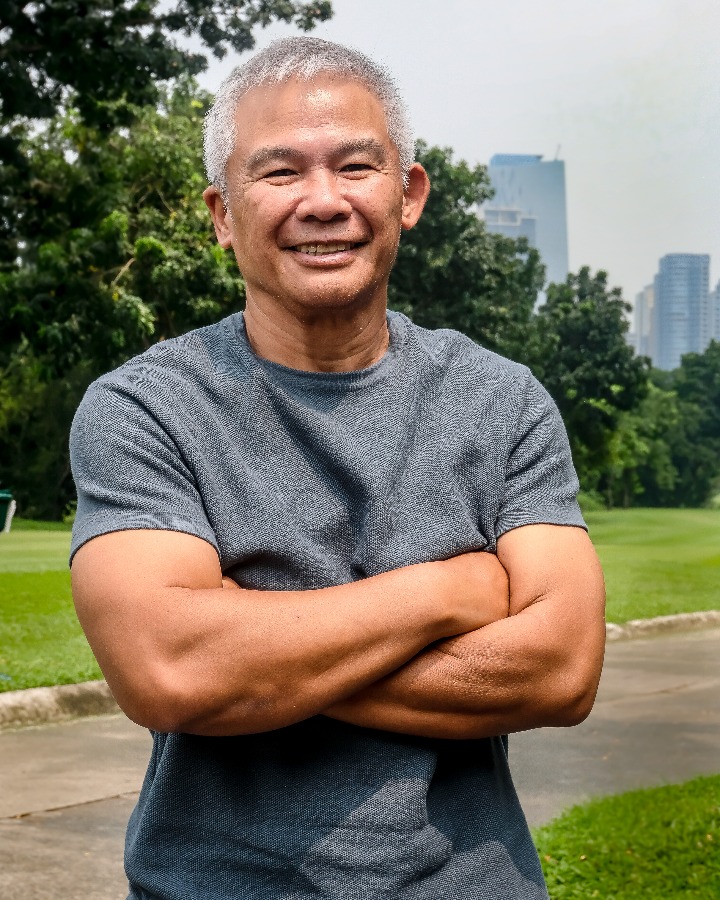
Reyes would find success and fulfillment in the corporate world while on sabbatical from basketball but as one of Manuel V. Pangilinan (MVP)’s most trusted stakeholders in the sport, he would later be asked to take over MVP’s flagship PBA team TNT, where he would once again work his magic and lead the Tropang Giga to a PBA Philippine Cup championship during the bubble season of 2021. It was the team’s first title after a six-year drought.
“I was happily and peacefully coaching TNT,” Reyes says. “We had just won a championship and we were celebrating in a beach resort actually when the call came from MVP.” Reyes recounts about how this last tour of duty with Gilas came about.
“In my mind I was done already with the national team, but of course, how can you say no to MVP, right? I wanted to know what was going on first with Tab (Baldwin), the current coach, and they explained to me the situation. I wanted to make sure that they fixed things with Tab first. Our initial inclination was to say no because we were very happy already. I was very content coaching TNT and I was very busy with my executive and leadership development business as well. That was going very well but, in the end, you know, you really cannot say no.”
Reyes has won five PBA championships for MVP so far. He has also worked as president of TV5, another MVP-owned company. In other words, Reyes has clearly proven his worth in the many years he has worked for the tycoon, but more than Pangilinan’s prodding, it was, once again, a greater calling that Reyes would feel compelled to answer.
“It’s really hard to say no to the call of flag and country,” he says. “That was the first of February. There was a game na pala February 21 and I didn’t know there was no team. I thought all the while they were practicing and then wala palang team. They were really struggling and hustling to put a team together so that was the situation where they really needed somebody to step in and fill the team for the window of games towards the latter part of February.
“That’s how that appointment came about and unfortunately a lot of people think up to now that I asked for it or that I grabbed it from Tab, that I took it from him,” he adds. “Not at all. In fact, I was Tab’s biggest cheerleader. I would always tweet about how happy I was with the performance of the team.”
Reyes would once again have to take the job out of necessity, albeit with much reservation. He was undoubtedly the most qualified for the position given the situation.
“I did not ask for this,” he says. “I did not apply for this. I was asked to step in with just a couple of weeks. I’m sure if we don’t perform well, people would understand. Little did I know how off the mark I was.”
‘Let this Cup pass from me’
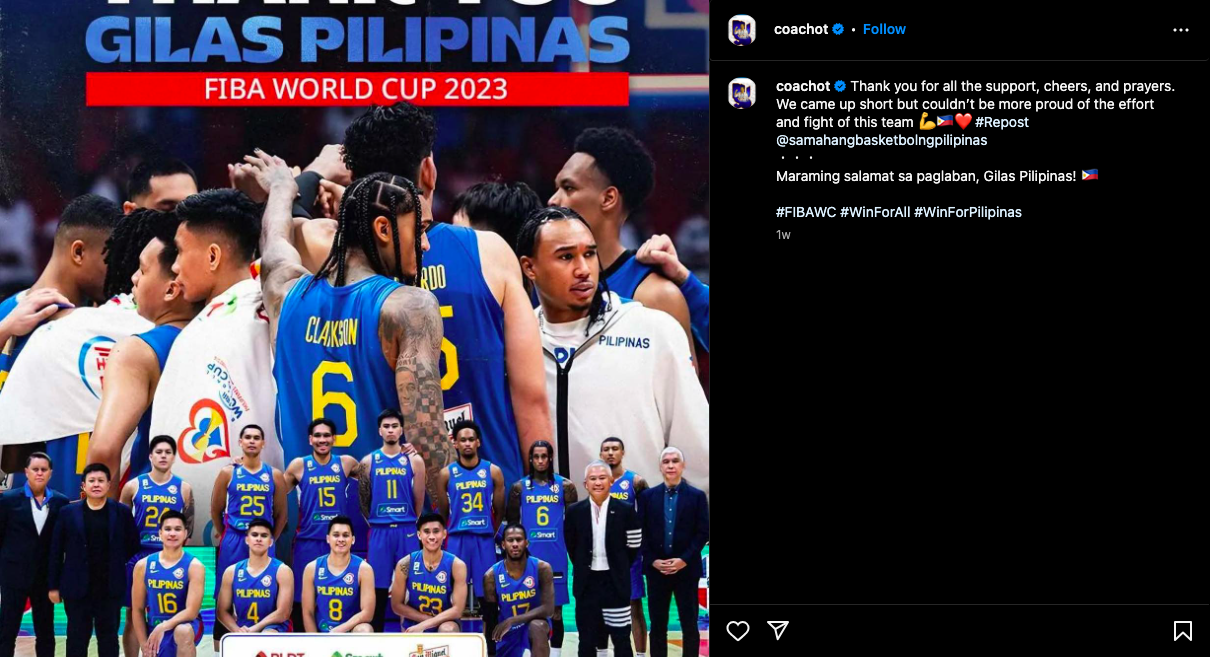
The best basketball teams in the world all converge quadrennially for the World Cup. The tournament is a virtual who’s who of all the basketball powerhouses in the globe—teams that have established systems and committed players that have played with each other in international competition for years.
And then there’s the Philippines. It’s public knowledge how we struggled with putting a team together with so little time for our players to gel before the competition. With the cards stacked against them, Gilas still fought and surprisingly, they stayed right there in the fight.
“We really put all our marbles in the Dominican Republic game,” Reyes says. “That is the one game we said as a team we had very little margin for error. We had to beat Dominican Republic otherwise, patay tayo.
“What happened, to be very honest, was really bad calls of the refs,” the coach says. “The refs made two very bad calls and it’s not only me who’s complaining. Even Luka Doncic was complaining, their coach, even the Italian coach got thrown out. If there’s one thing I regret, it’s sana we got better officiating. To miss an outright punch in the gut to Junemar (Fajardo) in the middle of the floor, for the refs to miss that, that’s kind of unforgivable, right? Can you imagine if Jordan (Clarkson) did not foul out? Sayang.”
Reyes is, of course, referring to Dominican Republic big man Angel Delgado getting away with a cheap shot on Fajardo in front of a record-setting home crowd at the Philippine Arena as well as two very questionable fouls called on Clarkson that caused him to foul out with 3:30 left with the game still within reach. Gilas Pilipinas would go on to lose their next two games against Angola and Italy as well as their classification round game with South Sudan. Throughout the games, Reyes was the object of rabid fans’ ire. His crucifixion was imminent. He was booed by the home crowd during the introductions or whenever his image would be flashed on the arena’s big screen.
Social media was just as unforgiving. Reyes was the frequent target of memes, jokes, and relentless bashing. Gilas finished its World Cup campaign by avoiding a sweep via a 96-75 win over China. At the post-game press conference, Reyes announced that he would be stepping down.
“When we lost to South Sudan, then I knew that we failed in our mission,” he says. “I did not step down naman because of social media. Of course, may effect ‘yon, but the real reason is because I didn’t deliver. It’s as simple as that,” Reyes shares. “I’m a firm believer that if you’re a leader, you have to hold yourself accountable. You come up, you have a job to do, you’re given a result that you have to attain, and if you don’t achieve it, no matter how justifiable, whatever the reasons, in the end, if you did not achieve it, then you have to take accountability and step aside.”
Post-Mortem
Hindsight is 20/20 and reviewing his team’s performance this last stand and comparing it with the previous World Cup standings, Reyes gives his personal assessment.
“If you think about it, we improved. We played better this year than we did in 2014. We placed number 21 in 2014 but there were 24 teams. Now we placed 24 out of 32 teams so we actually improved. I think in the end, when people say ang layo talaga natin sa iba or napag-iwanan tayo, dumikit nga tayo eh. Through all of the things they’re saying, na masama yung offense, ang daming error, hindi maka shoot ng 3-points, okay, andun na ako, pero paano tayo dumikit? Bakit tayo hindi tinambakan? If you’re telling me we played so bad, we shot so poorly, and the offense was so terrible, paano tayo dumikit? Are we bigger, faster or more athletic than those teams? So, I beg to disagree.
“Hindi tayo napag-iwanan,” Reyes says. “In fact, what we showed is that we’re right there. Through everything that went on here this World Cup, take away all the drama around it, if you really take an objective look, you will see that we improved, and we performed well. It’s just a matter of perception.
“Dati sinasabi ng mga tao makasabay lang tayo sa China okay na eh,” he continues. “Ngayon, kinakasabay natin Italy, Dominican Republic, pero hindi pa rin sapat. We had a one-in-six chance of advancing outright to the Olympics. If you were going to bet, would you bet on that happening with a 17 percent chance? It was a 17 percent chance to get that lone Olympic slot but we got the next best thing. We got an OQT slot when we beat China.”
Standing alone
It’s ironic how Reyes has stuck to a rallying cry for Gilas Pilipinas after all these years of serving the country, and the fans have failed to repay him even just that—having a heart—especially during these past few weeks. The lack of empathy and the amount of vitriol that Reyes has had to endure has been disappointing, to say the least. We’ve forgotten that at the end of the day, it’s still all just a game and there are bigger, far more important things that should matter. We forget that Reyes is someone’s husband. He’s someone’s father. He’s someone’s grandfather. The Reyeses have all had to bear with everything that’s been said about Coach Chot para sa bayan.
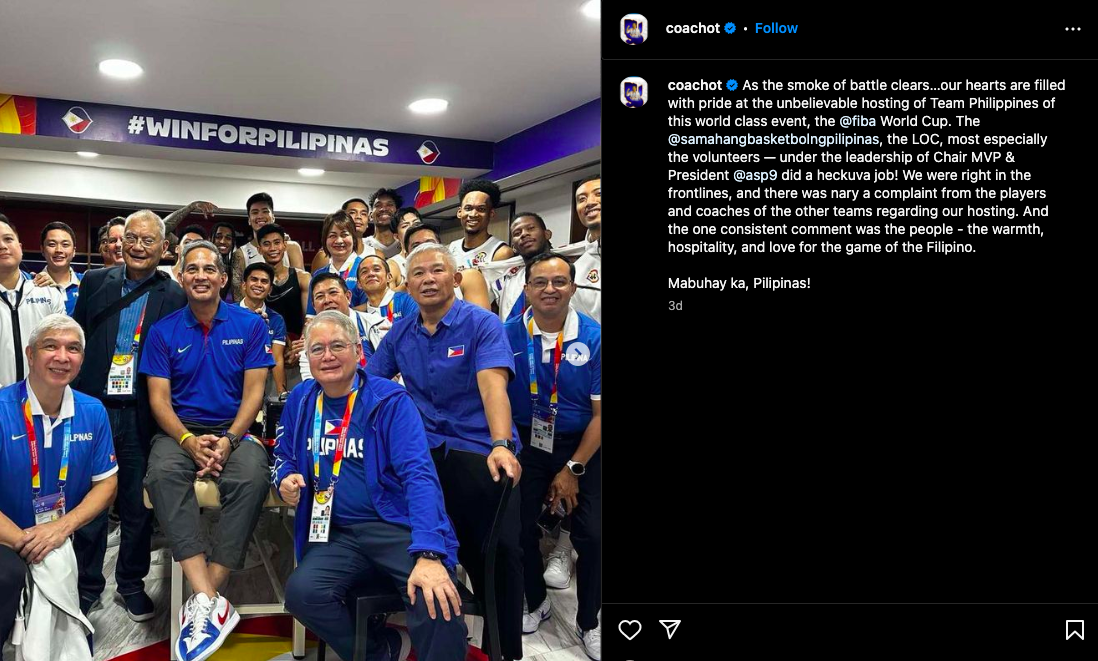
Through this entire ordeal, Reyes says that team management has been there. “They’ve been very supportive, but I must admit a lot of times, I felt alone,” he says. “I felt I was left to battle all of the problems, especially media and social media, by myself, and that’s when it really became very difficult and very heavy for me.”
As painful as all the hateful social media posts may have been for Reyes and his family, what still stings the most is the feeling of failure. “I got really hurt because I did not deliver,” he says. “There’s no worse feeling. There’s nothing anyone can do to me that will make me feel worse than that because of my own self-disappointment. That’s the most pain that I experienced after that loss.”
To the Detractors
When I asked Coach Chot if he had a message for his critics, even as he very calmly gave his answer, the sadness was palpable. Not anger. Just sadness.
“I hope you don’t ever, in your life, experience what I experienced,” he says. “I hope your kids don’t go through that, your family doesn’t go through that, because what I went through, I wouldn’t wish on my worst enemy. But I’m a very positive person. I’m a big believer in gratitude and at the end, we’re here.
“My family is healthy, we have a roof over our heads, there’s a lot to be grateful for and I don’t regret taking on the challenge because I think if I did not take it, it would have been a bigger cause of regret for me,” he adds. “To look in the mirror and say, ‘What if?’ But I’ve always believed when you take on a challenge, you get muddied, you get bloodied, but at least I can face anyone. The one thing I will tell my detractors is that at least I tried. Eh, ikaw, anong ginawa mo? At least, kami sumubok.”
Giving Thanks
Choosing to focus on the positive, Reyes had a few people he wished to express his gratitude to.
“First of all, the players. It was a real hard journey. Special mention to those who did not make it. They were the hardest cuts. You know, the Ravena brothers, they get so much flak but, in the end, si Thirdy at si Kiefer, pag tinawag mo, nandyan. Walang excuses. Ang itatanong lang nila sa ‘yo, kailan ako kailangan, coach, and they will be there. Kesa sa eto ngang si ganito si ganyan super galing pero wala naman. Dun ka na sa nandiyan kesa sa hihintayin mo pa, hindi mo alam kung dadating, or ang dami pang kundisyon.
“In defense of the Ravena brothers, I would go to war with them anytime,” he adds. “I really want to thank my players, especially those who did not make it. Special mention to Thirdy, Chris Newsome, Ray Parks. They deserved to be there but there were only 12 spots. I also want to thank the coaches who were with me every step of the way.
He saved the most important for last “My family, of course,” Reyes says. “They bore the brunt of all the hatred and bashing because I deactivated my Twitter and Facebook, so they were the ones seeing what was being written. I really appreciate and thank them. For me, those are the people who really stuck by us as well as a very small group of friends.”
On Coach Tim
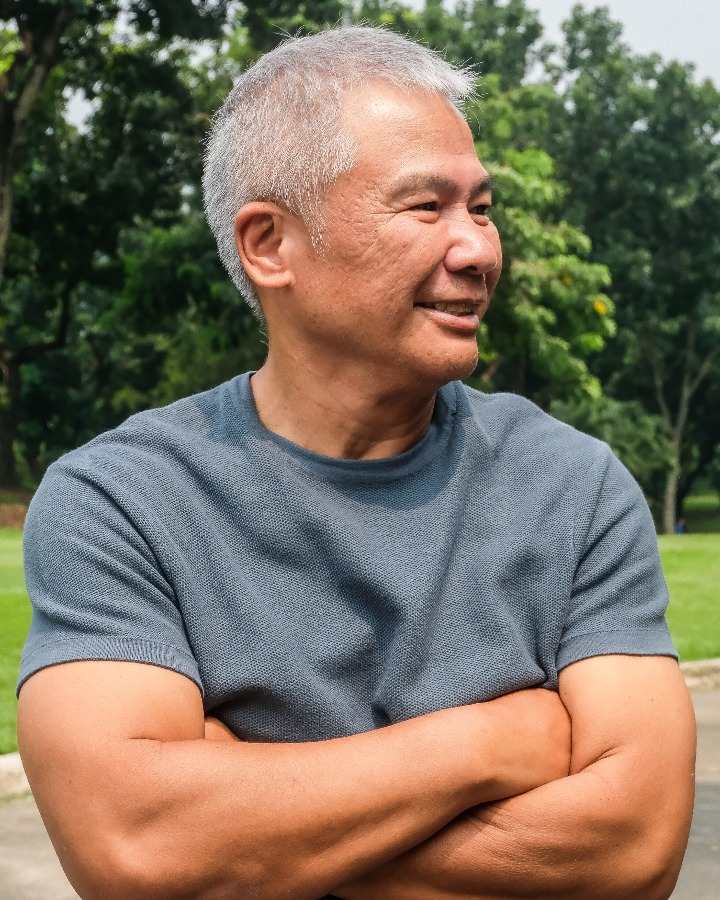
Coach Chot’s successor to revamp and lead Gilas Pilipinas in the upcoming Asian Games is someone very close to him in the person of his assistant coach and Ginebra mentor Tim Cone. Reyes and Cone go way back.
“I was his assistant in Alaska and the very first time I coached the national team in 2007, he was already helping me, but that was just short-lived,” he shares. “For his first head coaching job with the national team in 1998, the Centennial team, I was out of the PBA at the time, but he insisted that he would only take it if I was allowed to be his assistant so we go a long, long way back. We’re very, very good friends. Our wives are very good friends. Before he accepted, he called me first. He talked to me. I really encouraged him. Even before this, I already told him ‘You have to be ready. You should be the one next after me.’”
Apart from recommending Cone for the position, Reyes wishes the new head coach of Gilas nothing but the best, knowing the team is in good hands with the latter at the helm.
“Alam na nya yung gagawin,” Reyes says about Cone. “He already has a lot of experience. I think it was very important for him to be back coaching in the international stage this past year so it’s a perfect set-up for him. He coached the SEA Games team in 2019, but this time, being around this kind of team in the top level of competition in the World Cup, I think that has really prepared him coming into this tournament, this responsibility with his eyes wide open.”
Reyes also sees the improvement in how management is handling the transition of leadership, something that would have been helpful back when he took over from the previous coach.
“I think the way the SBP’s doing it now with Tim, the way they set it up now is that everyone is behind Tim because at that time, parang it wasn’t well-presented to the public. People had that perception that I grabbed the position.”
What’s Next
For now, Reyes is taking a much-deserved breather from the hardcourt.
“I’m taking a break first and then I’ll go back to TNT and then resume my executive business and leadership development practice which I kind of put on hold because of the World Cup,” he says. “I do a lot of work with organizations, companies, and multinational clients doing leadership workshops and team development workshops. That’s what I’ll go back to during the last quarter of the year. Hopefully, my clients are still there.”
The events of the past month will definitely help him with the work he does off the court. “A lot of companies ask me to talk about resilience and adversity. This is a real life example. I just have to tell the story. What could be a bigger adversity than being booed by your own home crowd? But in the end, after all the things that happened, I’m still here standing in front of you.”
A Legacy
Before we ended, I asked him what if, in the distant future, when the pain from World Cup 2023 has gone away, another call to serve flag and country comes along. Would he say yes like he has every other time before?
“Knowing what I know now, hindi na siguro,” Reyes says. “Of course, mahirap magsalita ng tapos but from where I’m sitting now and knowing what I know, how things are going to turn out, I don’t think so.”
Despite all the accolades, apparently Reyes had one grail missing that he really wanted to achieve before he calls it a career. “I really wanted to coach in the Olympics. In fact, I had several opportunities to be part of the contingent as an official, but sabi ko, kung magpaparada ako sa Olympics opening, sana as a competitor. I really wanted to have that opportunity. But maybe that’s gone now.”
Stepping down as head coach of the Philippine national team for what looks to be the last time, my final question was what he hopes people will remember when they hear the name ‘Chot Reyes’ and his answer was this: “That I fought until I could not fight anymore, for my country with all my heart. ‘Yun yung Laban Pilipinas. Puso.”
.png)
